The $50,000 Smile: The Art, Science, and Psychology of Closing Full-Arch Cases
There’s a unique energy in practices that consistently close high-value cases: not frantic or “salesy,” but calm and confident. When a patient comes in for an All-on-X Full-Arch Dental Implants consultation, they aren’t just buying titanium implants and zirconia teeth; they’re buying certainty.
Infinia Dental Lab has analyzed thousands of Full-Arch Dental Implants cases and identified what sets elite practices apart. We know a dental lab typically has no business telling a practice how to market. However, after watching top-performing offices consistently close high-value cases and speaking directly with leading marketing firms and practices, we’ve seen clear patterns in what actually works. The difference is rarely the surgeon’s clinical skill alone — it’s the structure, systems, and experience surrounding the patient.
Success in high-ticket dentistry doesn’t come from a “magic lead machine” dumping leads at your door. It comes from a fusion of behavioral psychology, rigorous lead management, and clinical technology that even serves as a marketing asset. This guide breaks down the operational mechanics that top-tier practices use to dominate the high-ticket arena.
1. The Physics of Lead Conversion: Speed and Decay
Generating leads is only half the battle – responding before they go cold is the real key. In the digital age, speed is a proxy for competence. Industry data shows 35–50% of sales go to the vendor that responds first, and some studies put that as high as 78%. An online lead’s “shelf life” is mere minutes. Contacting a web inquiry within 5 minutes dramatically boosts your chances of converting, whereas waiting 30 minutes or more can drop lead qualification odds by up to 80%. But speed alone isn’t enough – your team also has to be trained to turn that first contact into a booked consult, using multiple, value-based touchpoints (the kind of “keep showing up” philosophy Zig Ziglar preached) rather than a single, rushed phone call.
Immediate Response Protocol: Don’t rely on memory or a busy front desk to chase new leads. Implement an automated system that responds instantly – for example, an SMS or email acknowledging the inquiry and offering a prompt callback. When someone submits a “Teeth in a Day” form, they should get a text within 1–2 minutes: “Hi [Name], thanks for reaching out! We received your inquiry and would love to answer your questions. Is now a good time for a quick call?” On that call, the goal isn’t just to “answer questions” – it’s to connect, build trust, and secure a time on the calendar. This combo of fast response plus intentional touchpoints keeps the lead from drifting to the next dentist on their list.
2. The “High-Ticket” Mindset: Selling Clinical Certainty
Closing a $20k+ elective case starts with total team confidence. If any team member secretly thinks, “This is expensive,” that doubt can seep through to the patient. Everyone – doctor, treatment coordinator, assistants – must genuinely believe the patient will benefit enormously from the investment.
Technology = Confidence: It’s easier to be confident when you know the clinical result will be excellent. Leverage your lab and tech as selling points. For example, if you use photogrammetry and guided surgery (part of Infinia’s workflow), tell patients about it. Photogrammetry captures implant positions with micron-level accuracy, meaning the final teeth will fit precisely. This tech-enabled precision gives your team conviction and lets you sell the outcome (“a perfect fit and long-term durability”), not just the procedure.
Frame the Process, Not the Parts: Don’t let patients reduce the treatment to a commodity (“implants are implants”). Emphasize the advanced process and expertise that add value. For instance: “Our doctor uses a digital 3D scan to map your jaw, and we design your new smile on a computer. We work with a top lab to mill your final teeth from solid zirconia – the same kind of material used in aircraft – so they’re incredibly strong and custom-fit to you.” This kind of explanation shifts the conversation from price to quality. The patient sees that they’re paying for a high-precision, high-tech solution, not just a set of generic implants.
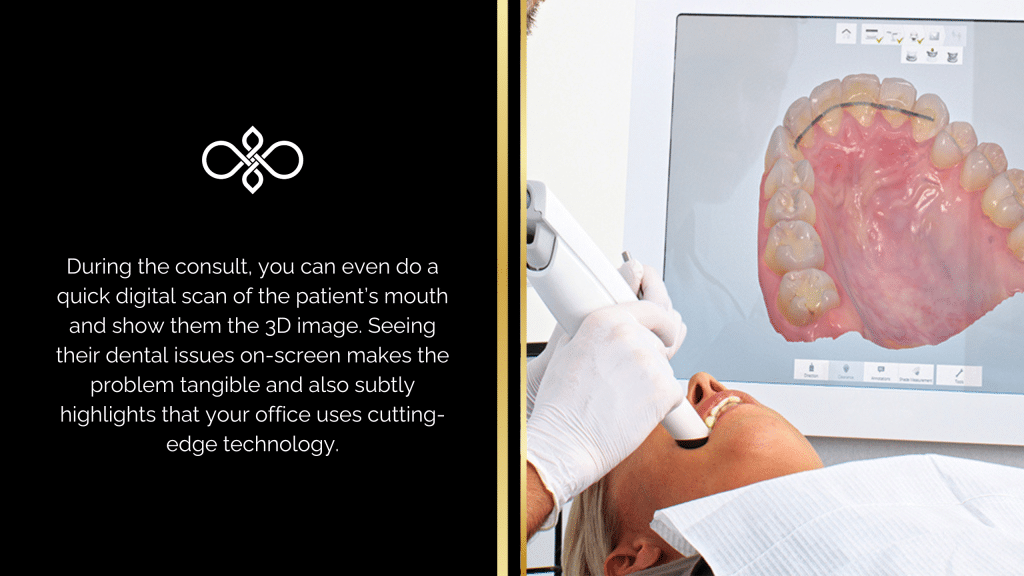
“No Goop” Impressions: A simple modern convenience – the intraoral scanner – can be a powerful marketing tool. Studies show 89% of patients prefer digital scans over traditional impressions. Explain that your practice uses “no-goop” digital impressions, so there are no gagging or bad-taste experiences. It builds trust: a patient is more likely to invest in a practice that feels high-tech and innovative.
3. The “Rule of 20”: Multiply Your Touchpoints
In 2025’s media-saturated world, a one-and-done marketing message won’t cut it – especially for a high-stakes decision like Full-Arch Dental Implants. Modern consumers often need 20+ interactions before committing. In fact, one analysis of big-ticket purchases (~$10k–$100k) found an average of ~35 touchpoints prior to closing. A prospective All-on-X patient might browse your website repeatedly, read reviews, check your social media, see an ad, receive an email newsletter, and so on. Each contact nudges them closer to or further from saying “yes.”
Ubiquity and Consistency: Aim to be everywhere your potential patient looks, with a consistent message. If they find your Facebook page after visiting your site, it should reinforce what they learned, not conflict or feel off-brand. Top practices ensure their website, social media, emails, and even office décor all tell a cohesive story (for example, emphasizing precision, comfort, and life-changing results). This way, no matter how many touchpoints it takes, the patient’s impression of your practice gets stronger and more positive each time.
Sensory Marketing in the Office: Don’t overlook the impact of the in-person experience – it’s a critical series of touchpoints in itself. For premium cases, the office should feel premium:
Smell:Rather than a “clinic” smell, consider a pleasant ambient scent (lavender, citrus, vanilla). A soothing scent can lower anxiety and make your office feel more like a spa than a medical facility.
Sight:Use warm lighting and modern, clean décor in waiting and consult areas. Patients should see visual proof of quality – whether it’s a wall of before-and-after photos or just an impeccably neat, well-designed space. An environment that feels high-end and caring helps justify a high-end price.
Touch: Little comforts can leave a big impression. Offer a soft blanket if they’re cold, a neck pillow during longer consultations, or a warm towel after a procedure. These hospitality touches make patients feel cared for and can subconsciously validate the cost (“you get what you pay for here”).
Every detail, from a quick website chat reply to the gentle scent in your office, contributes to a patient’s trust. By saturating their journey with positive, reinforcing touchpoints, you make it easier for them to choose you for treatment.
4. The Treatment Coordinator
Quarterback of the Close
The Treatment Coordinator: In high-value cases, the Treatment Coordinator (TC) plays a central role in converting an interested lead into a scheduled surgery. The TC should be a skilled communicator who understands both the clinical and financial sides of treatment, and they should guide the patient through the process with empathy. One powerful structure we’ve learned from The Closing Institute is the “10–10–10” framework: roughly 10 minutes with the TC to set expectations and build rapport, 10 minutes with the dentist for diagnosis and recommendations, and a final 10 minutes with the TC to review fees, financing, and next steps. Those time blocks can be longer in real life, but the sequence keeps the patient experience intentional and focused on a clear decision.
Strong Doctor-to-TC Handoff: The patient should feel like they are being handed from one expert to another. When the exam portion is done, the dentist might say in front of the patient: “I’m going to have you talk with [TC’s name] now – she’s our expert in guiding patients through the treatment details and figuring out comfortable payment options.” This simple introduction by the dentist elevates the TC’s status. The patient stays engaged, rather than thinking “Now I’m just with an office staff person.”
Overcoming the “Spouse” Objection: Many patients will say, “I need to discuss it with my spouse” as a polite exit. Anticipate this. Before they leave, arm the patient with key talking points. For example: “It’s important to let your husband know this is a comprehensive package – the fee covers the surgery, implants, sedation, and a set of fixed teeth, not just dentures. It also means you won’t have to keep paying for patchwork fixes in the future.” Encourage them to share why they feel the treatment is important for them (being able to eat, getting out of pain, etc.). By coaching the patient in what to say, you increase the chance their spouse will understand the value instead of just balking at the price.
Flexible Financing Options: Cost is often the biggest barrier to case acceptance – nearly 60% of adults have delayed dental care due to cost. However, acceptance jumps dramatically when financing is available. The TC should early-on introduce financing as a normal option. For instance: “Many of our patients use financing. For a $30,000 treatment, that can be as low as $500 a month.” Presenting the monthly cost puts the investment in perspective and often comes as a relief to patients who might assume they had to pay everything up front. By normalizing payment plans (much like buying a car or a home), you remove stigma and empower patients to move forward without financial fear.
5. The 7-38-55 Rule: Communication Congruence
The 7-38-55 Rule: Communication Congruence
What you say to patients is important – but how you say it is even more important. The classic 7–38–55 rule suggests that roughly 7% of a message comes from the actual words, 38% from tone of voice, and 55% from body language. If your words, tone, and body language aren’t aligned, patients will sense it. For example, if a patient asks, “Is this really going to work for me?” and you reply “Absolutely!” while frowning or sounding unsure, they’ll doubt the reassurance.
Aligned Communication: Make sure your team’s non-verbal cues match their verbal message:
Eye Contact: Look patients in the eye, especially when discussing treatment outcomes and fees. Steady eye contact projects confidence and honesty.
Tone: Keep your voice calm and clear. Don’t start mumbling or rushing when it’s time to talk about money. State the fee as a straightforward fact, without defensiveness or nervous laughter.
Body Language: Maintain an open, confident posture (no crossed arms or slouching). A genuine smile and a friendly nod go a long way to put patients at ease. Avoid fidgeting, which can signal anxiety.
Pause and Listen: After presenting a treatment plan or fee, resist the urge to fill the silence. Give the patient time to process and respond. This shows you’re confident and respectful of their decision-making.
The bottom line is that your confidence can instill their confidence. If the entire team consistently communicates certainty and empathy – in words, tone, and manner – patients will feel it and be more likely to trust in the treatment.
6. The “Numbers Game”: Relentless Follow-Up
Not all patients commit on the day of the consult. Many need time and multiple touches – and that’s where follow-up wins the case. With typical KPIs (key performance benchmarks) like 60% connection, 25% booking, 50% show, and 25% closed, the math can be sobering: out of 100 leads, you might connect with 60, book 15, have 7–8 actually show, and ultimately close about 2 Full-Arch Dental Implantscases. That means you can burn through dozens of leads before seeing a single yes – and many dentists assume “the marketing doesn’t work” when in reality, the funnel is working exactly as the numbers predict. If you want more closed cases at the same KPI levels, you don’t just need “better” leads; you need more leads and consistent, structured follow-up.
Structured Follow-Up Cadence: After the consult, have a simple, repeatable sequence:
Next Day: Personal thank-you and quick recap.
3 Days: Send value (testimonial, FAQ, recovery info).
1 Week: Check in about financing and answer questions.
2 Weeks: Gentle urgency (limited dates, healing by a key event).
1 Month+: Move to long-term nurture with periodic check-ins and success stories.
The key is consistency. You’re not nagging—you’re showing that you care, you’re still there, and you’re ready when they are. Over time, that persistence is what turns a small percentage of leads into a steady pipeline of high-value cases.
Conclusion: Turning Structure Into Predictable Growth
The difference is rarely the surgeon’s clinical skill alone — it’s the structure, systems, and experience surrounding the patient.
When you:
Respond to inquiries within minutes, not hours,
Run a consistent, confidence-driven consultation process,
Communicate with alignment in words, tone, and body language, and
Follow up with discipline instead of emotion,
your KPIs begin working for you instead of against you.
But the most overlooked—and most powerful—lever is this: Patients don’t buy parts, materials, or procedures; they buy the experience and certainty of the entire process.
In full-arch dentistry, where decisions are emotional, financial, and life-changing, emphasizing the complete patient journey—from first contact to final delivery—creates trust, reduces friction, and removes the need to “sell.” When the process is clear, intentional, and repeatable, confidence replaces pressure.
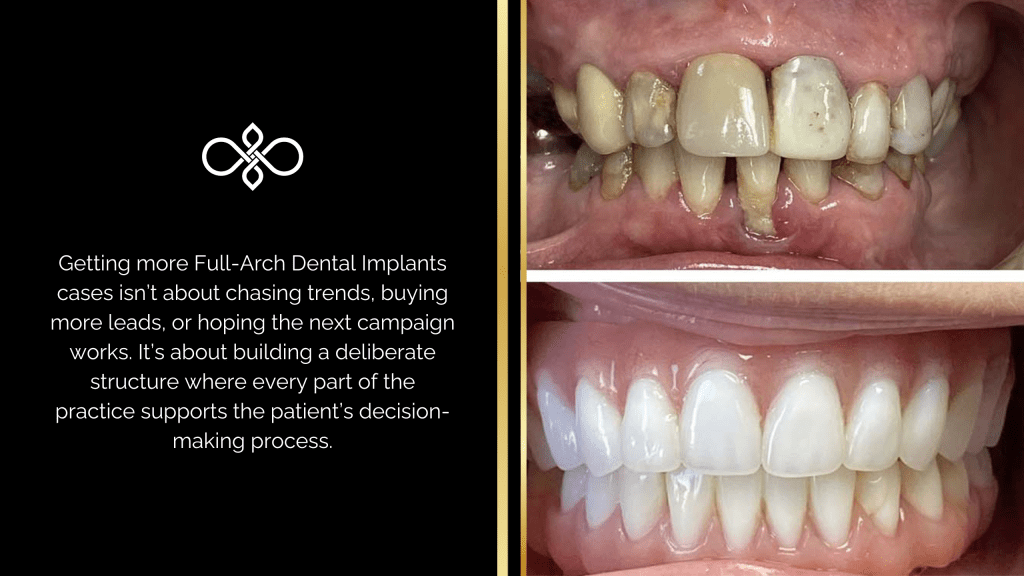
The result is a steady, predictable flow of full-arch cases where patients feel guided rather than sold, teams feel aligned rather than stressed, and $50,000 smiles become a sustainable outcome of a well-built system, not a rare win.
Infinia Dental Lab is a leader in digital restorative dentistry, specializing in All-on-X implant workflows. We partner with forward-thinking practices to streamline Full-Arch Dental Implants cases using advanced technologies like photogrammetry, facial scanning, and 3D printing. Our mission is to support clinicians in delivering life-changing smiles with precision and efficiency. Visit infiniadental.com to learn how we can help elevate your full-arch practice.